

The District Heating Market is projected to expand at a 5% CAGR, reaching a value of $232.3 billion by 2030.
District Heating Market
District Heating Market industry
District Heating Market share
The Business Research Company’s District Heating Global Market Report 2026 – Market Size, Trends, And Forecast 2026-2035
LONDON, GREATER LONDON, UNITED KINGDOM, October 12, 2026 /EINPresswire.com/ -- The district heating market is evolving rapidly, driven by a combination of technological advancements and environmental priorities. As cities grow and the need for sustainable energy solutions intensifies, this sector is becoming increasingly vital. Let’s explore the current market status, regional dynamics, key players, and the factors shaping the future of district heating worldwide.
Anticipated Growth Trajectory of the District Heating Market
The district heating market is expected to surpass $232 billion by 2030. Within the larger machinery sector, which is projected to reach $5,280 billion by the same year, district heating will represent nearly 4% of the total market value. Analysts forecast a compound annual growth rate (CAGR) of 4% leading up to 2030, indicating steady expansion fueled by rising demand for efficient energy systems.
Request A Free Sample Of The District Heating Market Report
https://thebusinessresearchcompany.com/sample_request?id=15008767&type=smp&name=District%20Heating%20Market%20Report%202026&utm_source=EINPresswire&utm_medium=Paid&utm_campaign=Oct_PR
Regional Market Outlook for District Heating
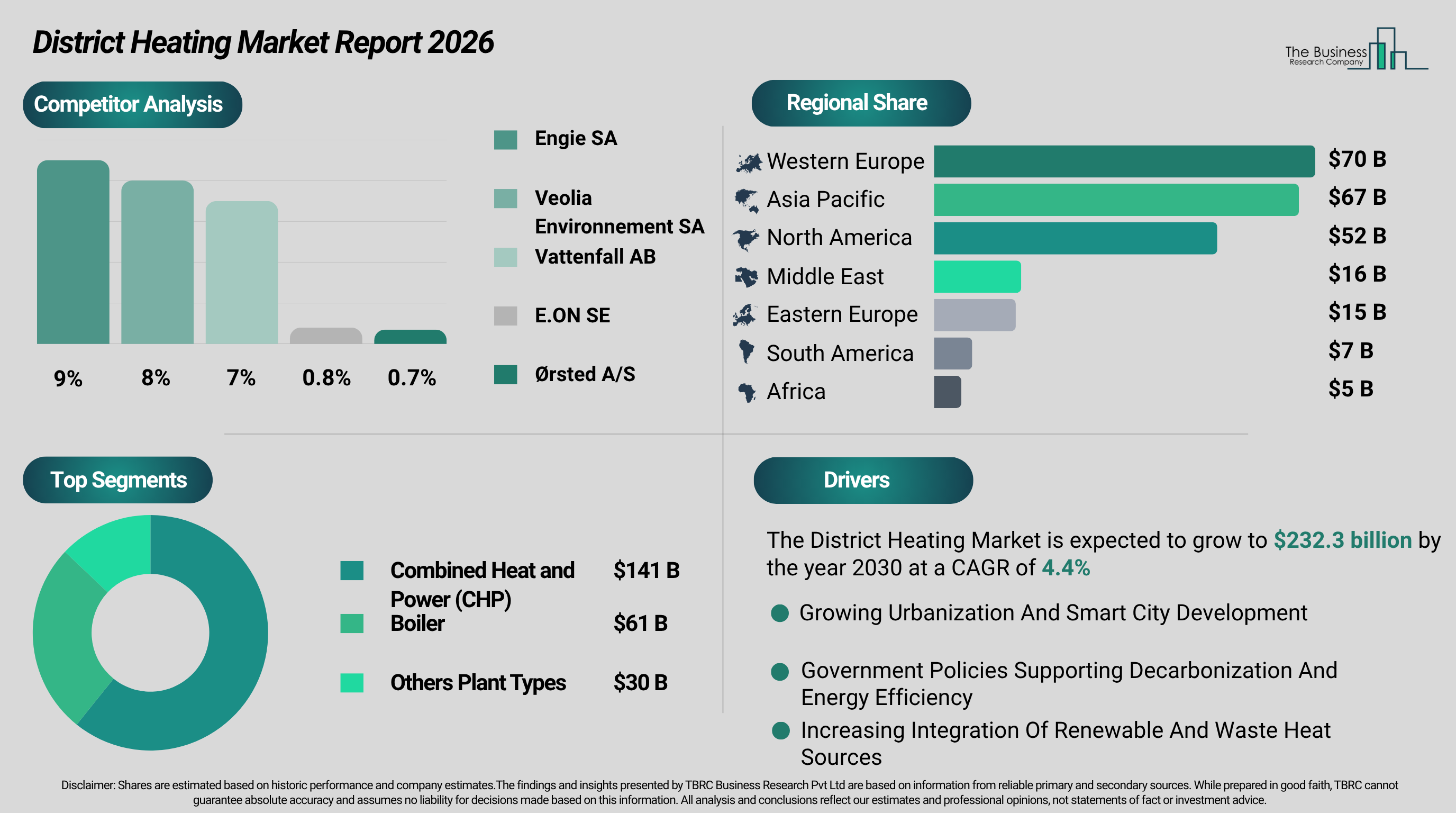
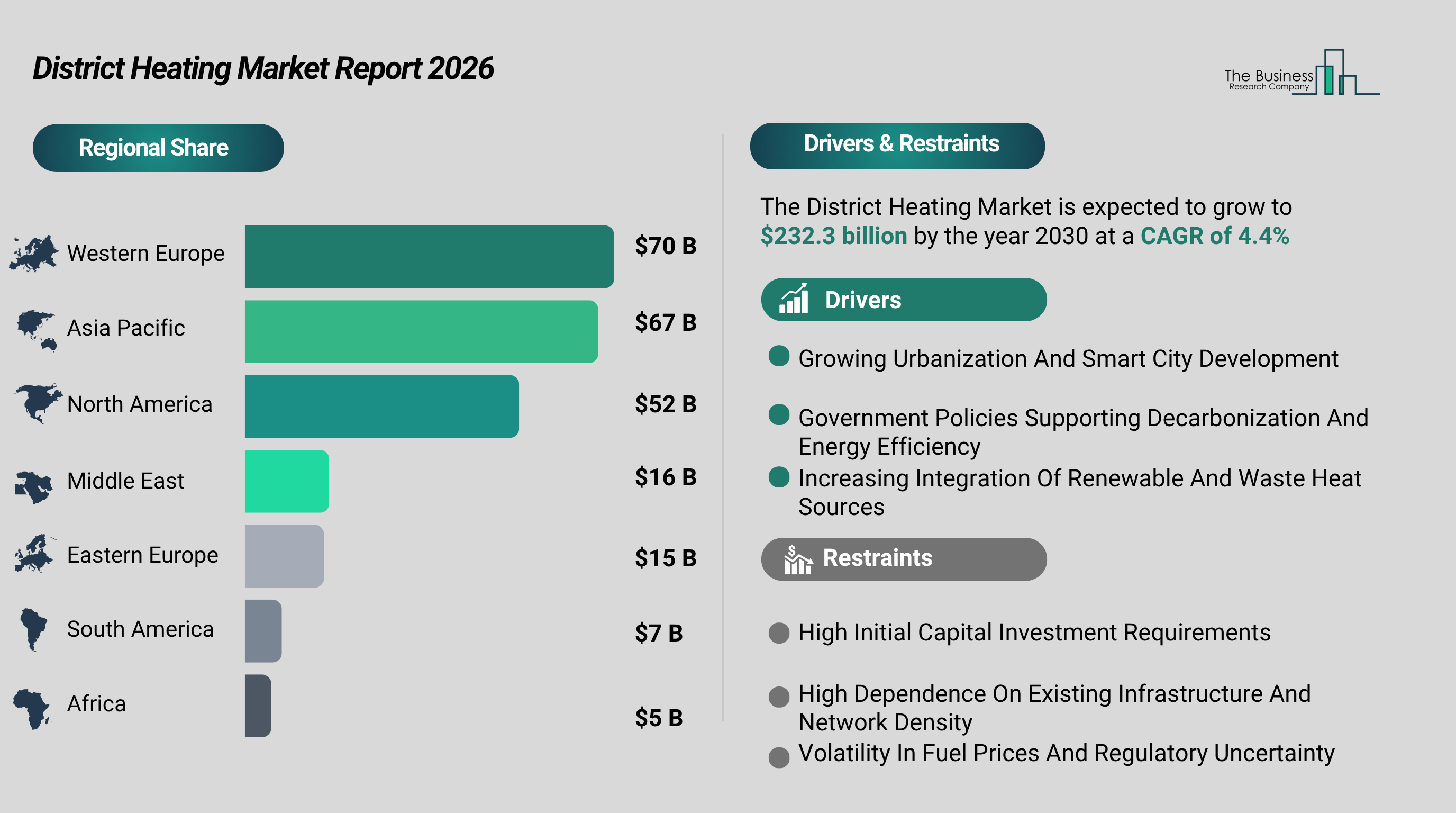
Western Europe is poised to remain the dominant regional market for district heating by 2030, with an estimated valuation of $70 billion, up from $57 billion in 2025. This growth at a CAGR of 4% reflects ongoing upgrades of aging heat infrastructure, investment in low-carbon urban energy systems, increasing utilization of waste heat, and supportive government policies promoting centralized heating for improved energy efficiency. In the United States, the market is predicted to reach $46 billion by 2030, growing from $37 billion in 2025 at a similar 4% CAGR. Expansion will be driven by the adoption of district energy systems on institutional campuses, robust urban infrastructure projects, and a strategic focus on reducing long-term building energy expenses through shared heating networks.
Dominant Plant Types in the District Heating Market
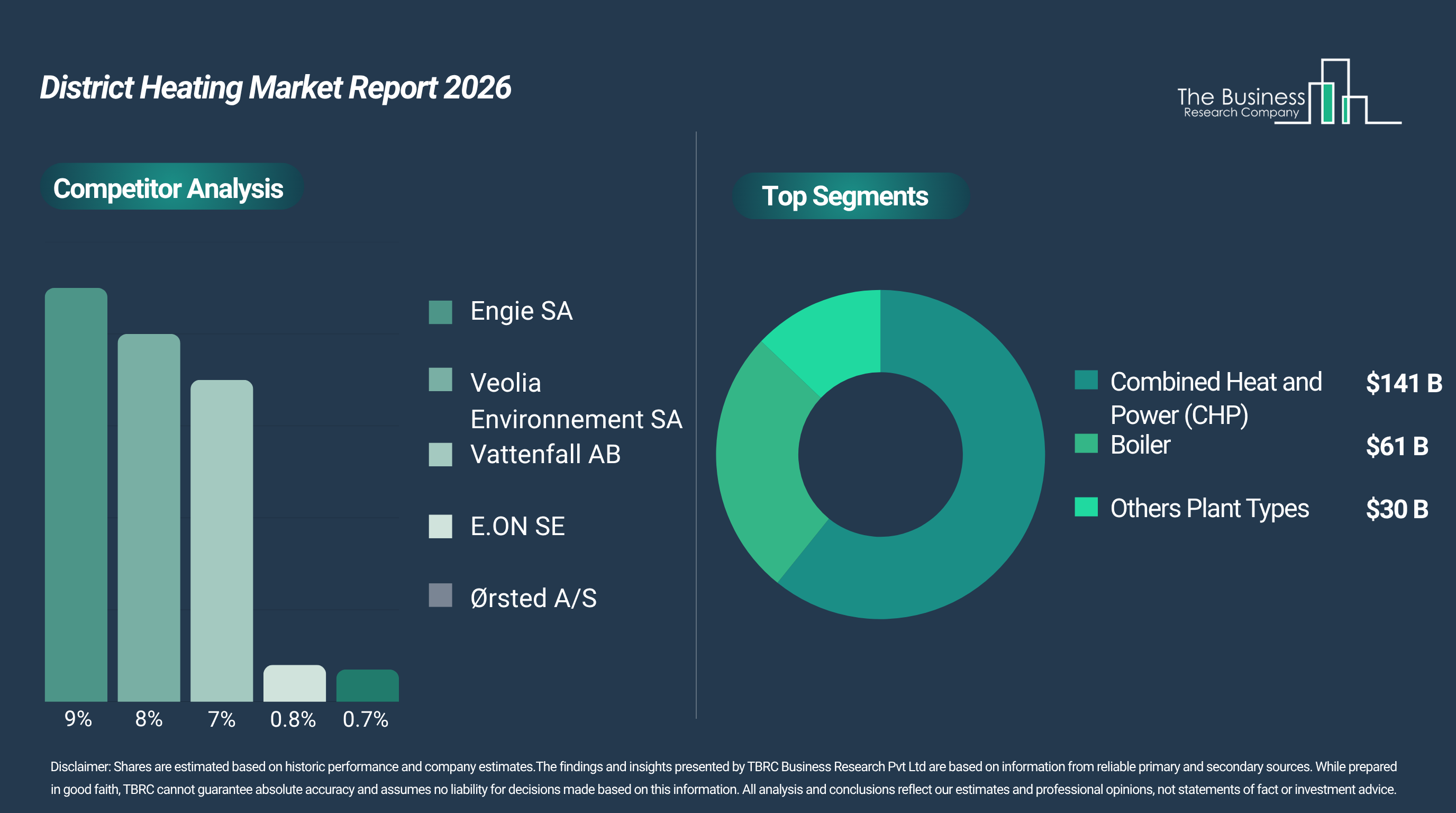
Among various plant types, combined heat and power (CHP) systems are expected to be the leading segment by 2030, capturing 61% of the market share, equating to $141 billion. The rise of CHP is attributed to its high efficiency in generating both electricity and heat simultaneously, the decentralization of heat production for urban networks, and technological improvements that enhance fuel use and reliability. Besides CHP, the market is also segmented by heat sources such as coal, natural gas, renewables, and oil and petroleum products, and by application areas including residential, commercial, and industrial sectors.
Access The Detailed District Heating Market Report Here
https://thebusinessresearchcompany.com/report/district-heating-global-market-report?utm_source=EINPresswire&utm_medium=Paid&utm_campaign=Oct_PR
Urbanization and Smart City Growth Boosting District Heating Demand
Rapid urbanization and the rise of smart city initiatives are significant engines behind district heating market growth. Dense metropolitan areas require centralized heating solutions to provide dependable and efficient thermal energy to various users, including homes, offices, and institutions. Smart city programs favor the adoption of digitally managed heating networks that optimize distribution, minimize heat loss, and balance consumption through real-time monitoring and automation. This trend is expected to add roughly 2.2% annually to the market’s growth rate.
Policy Support for Decarbonization and Energy Efficiency Encourages Market Expansion
Governmental regulations and incentives aimed at reducing carbon emissions and promoting energy efficiency are key drivers in the district heating sector. Climate neutrality goals, renewable energy mandates, financial backing, and infrastructure investments are motivating utilities and municipalities to modernize urban heating networks. This support helps accelerate the transition from fossil fuels to low-carbon heat sources, contributing approximately 2.0% per year to market growth.
Renewable and Waste Heat Integration Enhancing District Heating Systems
Increasingly, district heating networks are incorporating renewable energy and waste heat sources, including industrial byproducts, geothermal energy, biomass, solar thermal, and large heat pumps. This diversification improves energy security, lowers operating costs, and makes heating systems more sustainable. The integration of these green heat sources is anticipated to drive around 1.8% annual growth in the market through 2030.
Market Leadership and Share in District Heating
In 2025, Engie SA held the top position globally with a 9% share of the district heating market, as reported by The Business Research Company. Engie’s energy solutions division specializes in delivering district heating networks, combined heat and power systems, renewable and low-carbon heat infrastructure, and digital energy management solutions aimed at efficient heat distribution and urban energy decarbonization.
Competitive Landscape and Industry Fragmentation
The district heating industry is moderately fragmented, with the top ten firms accounting for 27% of total revenue in 2025. This reflects significant entry barriers, including heavy capital investment needs, strict environmental and efficiency standards, complex network construction, and the challenge of providing reliable, affordable, and low-carbon thermal energy. Leading companies maintain their positions through extensive portfolios, strategic utility partnerships, and ongoing innovation in heat generation and management. As the market evolves, collaborations and technological advances are expected to reinforce their foothold.
Current Market Shares of Leading Companies
The foremost companies in the district heating market as of 2025 include:
1. Engie SA – 9%
2. Veolia Environnement SA – 8%
3. Vattenfall AB – 7%
4. E.ON SE – 1%
5. Ørsted A/S – 1%
6. RWE Aktiengesellschaft – 1%
7. Danfoss A/S – 0.3%
8. Helen Oy – 0.3%
9. Fortum Oyj – 0.3%
10. Vital Energi Utilities Limited – 0.2%
Innovations and Trends Transforming District Heating
Low-carbon heat networks are fundamentally changing the district heating market by enhancing energy efficiency and slashing carbon emissions. For example, in November 2025, Veolia Environnement S.A. introduced the ecothermal grid in the United Kingdom, a low-carbon heat network equipped with AI-driven smart controls, energy storage, and waste heat recovery. These technologies optimize heat distribution, boost operational efficiency, and provide reliable sustainable heating and cooling for urban developments.
Strategies Market Players Use to Maintain Leadership
Key approaches adopted by district heating companies include:
- Developing advanced technologies to raise energy efficiency and system dependability
- Integrating renewable energy to support low-carbon heat generation
- Expanding infrastructure to improve energy security and network reach
- Employing AI and digital tools to refine monitoring and operational performance
Future Market Opportunities in District Heating to 2030
Significant growth potential exists across the combined heat and power (CHP), boiler, and other plant type segments, which together are forecasted to add more than $45 billion in value by 2030. CHP alone is expected to grow by $27 billion, boilers by $12 billion, and other plant types by $6 billion between 2025 and 2030. Innovations such as fourth-generation district heating networks, intelligent heat distribution, thermal energy storage, hybrid heat generation, and digital network optimization will be key drivers for this expansion, enhancing efficiency while reducing carbon footprints.
Major Participants Shaping the District Heating Market
The district heating market features a range of prominent companies, including Engie SA, Veolia Environnement SA, Vattenfall AB, E.ON SE, Ørsted A/S, RWE Aktiengesellschaft, Danfoss A/S., Helen Oy, Fortum Oyj, Vital Energi Utilities Limited, Eidsiva Bioenergi AS, Göteborg Energi AB, STEAG GmbH, LOGSTOR A/S, Alfa Laval AB, Statkraft AS, FVB Energy Inc., Ramboll Group A/S, Keppel Limited, and Hafslund Eco AS.
Key Raw Material Suppliers Fueling the Market
Critical raw material suppliers in this sector encompass ArcelorMittal S.A., Nippon Steel Corporation, Tata Steel Limited, JFE Steel Corporation, Salzgitter AG, SSAB AB, Vallourec S.A., Tenaris S.A., Georg Fischer AG, Uponor Corporation, LOGSTOR A/S, Isoplus Fernwärmetechnik GmbH, Brugg Pipes Systems, GF Piping Systems, Saint-Gobain PAM, BASF SE, Covestro AG, Dow Inc., Huntsman Corporation, Wacker Chemie AG, Evonik Industries AG, LyondellBasell Industries N.V., Borealis AG, Sika AG, and LANXESS AG.
Distribution Networks Supporting District Heating
The distribution network is upheld by major wholesalers and distributors such as Ferguson Enterprises, Inc., WESCO International, Inc., Rexel S.A., Sonepar Group, Wolseley UK Limited, Winsupply Inc., HD Supply Holdings, Inc., MRC Global Inc., Core & Main Inc., Hajoca Corporation, Van Meter Inc., City Plumbing Supplies Holdings Limited, BSS Industrial, Inc., Trupply LLC, Keller & Kalmbach GmbH, ERIKS N.V., Brammer plc, Fastenal Company, Grainger, Inc., Rubix Group International, Berner Group Holding SE, Haberkorn GmbH, Colliflow Pipe Systems B.V., Onninen Oy, and Ahlsell AB.
End Users Driving Demand in the District Heating Market
Key customers include Fortum Corporation, Vattenfall AB, Veolia Environnement S.A., ENGIE S.A., E.ON SE, Statkraft AS, Helen Ltd., Ørsted A/S, Kelag Wärme GmbH, Danfoss A/S, STEAG GmbH, Göteborg Energi AB, Stockholm Exergi Holding AB, Helen Energy Company Ltd., Keppel DHCS Pte. Ltd., Tabreed PJSC, Shinryo Corporation, NRG Energy, Inc., Enwave Energy Corporation, Ramboll Group A/S, Wien Energie GmbH, SWM Stadtwerke München GmbH, MVV Energie AG, and Getec Energie Holding GmbH.
What’s included in our 2026 market reports:
• Market attractiveness scoring and analysis
• Total addressable market (TAM) analysis
• Company scoring matrix graphics and tables
• Excel-based forecasting dashboards
• Market hotspots infographics
• Key technologies and future trend analysis
• Updated graphics and tables
Learn More About The Business Research Company
The Business Research Company (www.thebusinessresearchcompany.com) is a leading market intelligence firm renowned for its expertise in company, market, and consumer research. We have published over 30,000+ reports across 27 industries and 60+ geographies. Our research is powered by 1,500,000 datasets, extensive secondary research, and exclusive insights from interviews with industry leaders.
We provide continuous and custom research services, offering a range of specialized packages tailored to your needs, including Market Entry Research Package, Competitor Tracking Package, Supplier & Distributor Package and much more.
Disclaimer: Please note that the findings, conclusions and recommendations that TBRC Business Research Pvt Ltd delivers are based on information gathered in good faith from both primary and secondary sources, whose accuracy we are not always in a position to guarantee. As such TBRC Business Research Pvt Ltd can accept no liability whatever for actions taken based on any information that may subsequently prove to be incorrect. Analysis and findings included in TBRC reports and presentations are our estimates, opinions and are not intended as statements of fact or investment guidance.
Contact Us:
The Business Research Company
Americas +1 310-496-7795
Europe +44 7882 955267
Asia & Others +44 7882 955267 & +91 8897263534
Email: marketing@tbrc.info
Follow Us On:
LinkedIn: https://in.linkedin.com/company/the-business-research-company
Oliver Guirdham
The Business Research Company
+44 7882 955267
info@tbrc.info
Visit us on social media:
LinkedIn
Facebook
X
Legal Disclaimer:
EIN Presswire provides this news content "as is" without warranty of any kind. We do not accept any responsibility or liability for the accuracy, content, images, videos, licenses, completeness, legality, or reliability of the information contained in this article. If you have any complaints or copyright issues related to this article, kindly contact the author above.
